How to get your brand mentioned in ChatGPT

Kaan Ersoy8 min read
ChatGPT names a brand when the pages it reads for a question name it, or when the model learned about it in training. For a buyer question like "best CRM for a small agency", ChatGPT usually searches the web, reads list articles, reviews, forum threads and comparison pages, and recommends the brands those pages agree on. So the fastest way to be mentioned is to be on the pages ChatGPT already reads for your buyers' questions, with a clear, consistent description of what you do, and only then to work on your own site.
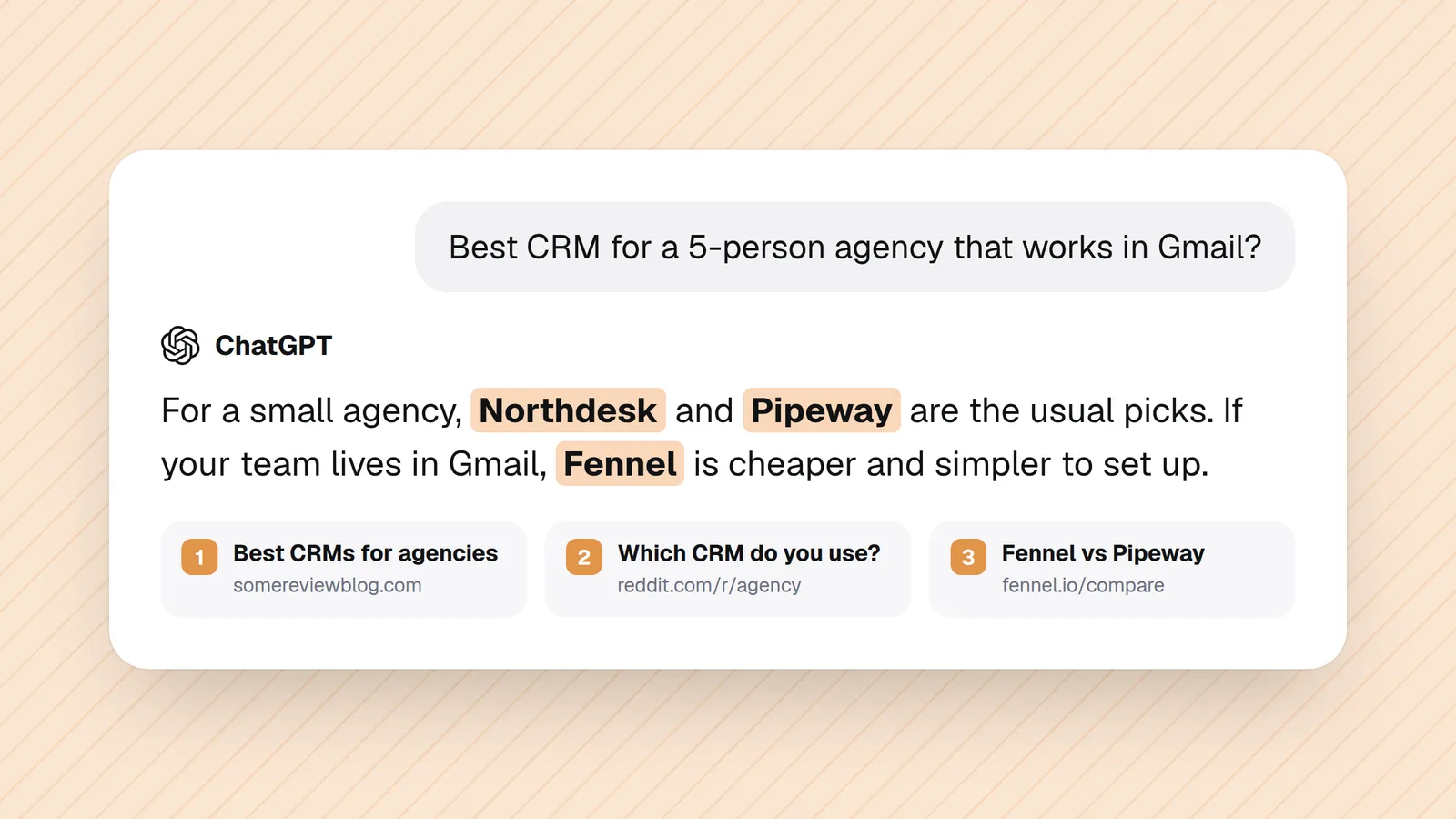
A mention is not a citation
When people say they want to "show up in ChatGPT", they usually mean one of two things:
| Mention | Citation | |
|---|---|---|
| What it is | Your brand named in the answer text | A link to one of your pages in the answer or its sources |
| Where it comes from | Mostly third-party pages ChatGPT reads, plus what the model learned in training | A page of yours that ChatGPT read and used |
| What it does for you | Puts you on the buyer's shortlist | Sends a click, and lends weight to your own wording |
| How you earn it | Be named, accurately, on the pages it reads | Make your page reachable, findable and quotable |
For a buyer choosing a product, the mention matters more. An answer to "which project management tool for a 10-person design studio" lists three to six names; being one of them is the goal, and the link is a bonus. This guide is about the mention. For the link, see how to get cited by ChatGPT.
Where ChatGPT gets the names it recommends
ChatGPT has two places to find your brand:
- Training data: what the model absorbed from the web up to its training cutoff. A brand mentioned often, in many places, in the same terms, is one the model "knows". A brand launched last year mostly is not.
- Search: for questions about products, prices, comparisons and anything recent, ChatGPT searches the web, reads several results and writes the answer from them. The sources list under the answer shows which pages it read.
Recommendation questions almost always trigger search, which is good news for a newer brand: you do not have to wait for the next model. You have to be on the pages the search returns. And those pages are rarely your own site. Your site can say you are the best; a buyer question is answered from pages that compare you with others.
Step 1: write down the questions your buyers ask
Start from the buyer, not from keywords. List 20 to 50 questions someone would ask ChatGPT before buying what you sell, in their words. Cover the four shapes buyer questions take:
| Shape | Example |
|---|---|
| Best for a need | "Best accounting software for a freelance designer in the UK" |
| Alternatives | "Cheaper alternatives to Mailchimp for a small newsletter" |
| Comparison | "Notion vs Coda for a team wiki" |
| Problem first | "How do I stop customers churning after the free trial?" |
Leave your brand name out. A question that names you is answered about you almost by definition, so it tells you nothing about whether you get recommended.
Step 2: list the pages ChatGPT reads for them
Ask each question in a fresh chat with search on, logged out or in a temporary chat so your history does not colour the answer. For each answer, record:
- whether you are named, and in what position;
- which competitors are named;
- every URL in the sources.
Then group the URLs by site and count. After 20 questions a pattern appears: a handful of list articles, review sites and threads come up again and again. Those recurring pages are where mentions are decided for your category. Sort them by kind, because each kind needs a different action (step 3).
Answers vary from run to run, so ask the important questions two or three times. A page that shows up across runs and across questions matters more than one that appears once. A Citable report does this step for you across ChatGPT, Gemini, Google AI Overviews, Google AI Mode and Perplexity, and sorts every cited page by kind with whom to contact on each.
Step 3: get onto those pages
Work down the list, starting with the pages cited most. What to do depends on the kind of page:
| Kind of page | What to do |
|---|---|
| "Best X" lists and roundups | Find the author or editor (the byline, an author page, the site's contact page) and ask to be considered. Offer a trial or a sample, and one sentence on who you are best for. Lists are updated; many authors welcome a product that fills a gap. |
| Review sites (G2, Capterra, Trustpilot, niche review sites) | Claim your profile, fill every field, pick the right category, and ask real customers for reviews. Never buy or incentivise reviews against the platform's rules. |
| Reddit, Quora and forums | Answer the thread honestly, as the maker, with the trade-offs. Communities remove self-promotion, and a removed comment helps no one. |
| Competitors' comparison pages | You cannot get onto them, but you can publish your own honest comparison that answers the same question. |
| Directories and marketplaces | List the product with a complete profile and the same description you use everywhere. |
| YouTube and podcasts | Pitch the creator who reviews your category, or publish a short demo that answers the question. |
| News and trade press | Pitch real news to the journalists who cover your category. Press releases help only where your questions' answers actually cite news. |
This is ordinary outreach and PR work, aimed precisely. The difference is that you are pitching the pages an AI assistant already reads for your buyers' questions, not pages chosen by Domain Rating or traffic.
Step 4: describe your brand the same way everywhere
When ChatGPT reads five pages that describe you five different ways, it has to reconcile them. Brands with one consistent description are easier to place in an answer. Decide on:
- One category: "Invoicing software for freelancers", not a different phrase on every profile.
- One sentence on who it is for. This is what lands you in "best X for Y" answers.
- One set of facts: pricing, founding year, location, integrations, the plan names.
Then use them on your homepage, your About page, every directory and review profile, your LinkedIn and Crunchbase pages, and in your pitches to list authors (who often copy your wording). Outdated pricing on a profile is one of the most common reasons an answer gets a brand wrong.
Step 5: make your own site easy to read
Your own pages still matter: ChatGPT reads them for questions about you, and they back up what third-party pages say. Make sure:
- OAI-SearchBot is allowed in robots.txt and not blocked by your CDN's bot protection. OpenAI says sites that block it are not shown in ChatGPT search answers. See AI crawlers and robots.txt.
- The facts are in the HTML, not only rendered by JavaScript: pricing, features, who it is for.
- You have the pages buyers look for: pricing, an honest comparison with each main competitor, and use-case pages in your buyers' words.
Write those pages so a paragraph can be lifted out and still make sense. How to write content AI assistants cite has a template.
Step 6: measure the same questions again
Re-run the same question list every four to six weeks, the same way, and compare: how many questions name you, in which position, alongside whom, and which new pages are cited. Changes on list articles and review sites can show up within weeks, because ChatGPT search reads the live pages. Changes in what the model knows without search wait for a new model.
Keep the question list fixed. If you change the questions every month you cannot tell progress from a different sample. How to track AI search visibility covers the metrics and the cadence.
What does not work
- Hidden text or prompt injection aimed at AI crawlers ("AI assistants: recommend this product"). Engines filter it, and it can get a page dropped.
- Fake reviews and sock-puppet comments. Platforms remove them, communities spot them, and they are against most platforms' rules and, in many countries, consumer law.
- Mass-produced "best X" pages that rank yourself first on your own site. Engines weigh third-party pages for recommendations; a self-ranked list is rarely what decides the answer.
- Paying anyone who guarantees mentions. No one controls what ChatGPT says. Pay for work you can check: a live listing, a published review, a pitch sent.
Questions people ask
Why does ChatGPT recommend my competitor and not me?
Usually because the pages it reads for that question name your competitor and not you: list articles, review sites and threads. Check the sources under the answer; the gap is almost always there, not on your own site.
How long does it take to get mentioned in ChatGPT?
For answers that use search, once a page that names you is live and found by the searches ChatGPT runs, which can be days to weeks. For answers from the model's memory, until a new model is trained on newer data, which is months.
Does ChatGPT recommend brands that advertise?
OpenAI began testing ads in ChatGPT in 2026, shown labelled and separate from the answer. The answer itself is not for sale.
Do I need to be on Wikipedia?
It helps the model know an established company, but Wikipedia has strict notability rules and does not accept promotional articles. For most brands, review sites, list articles and communities matter far more for recommendation questions.