How to get cited by Perplexity

Kaan Ersoy6 min read
Perplexity searches the web for every question and cites the pages it used, numbered, next to the answer. To be cited, a page has to be reachable by PerplexityBot, returned by the searches Perplexity runs for the question, and specific enough to quote. To be named in its recommendations, your brand has to be on the pages it reads for your buyers' questions, which are mostly lists, reviews, communities and video, not your own site.
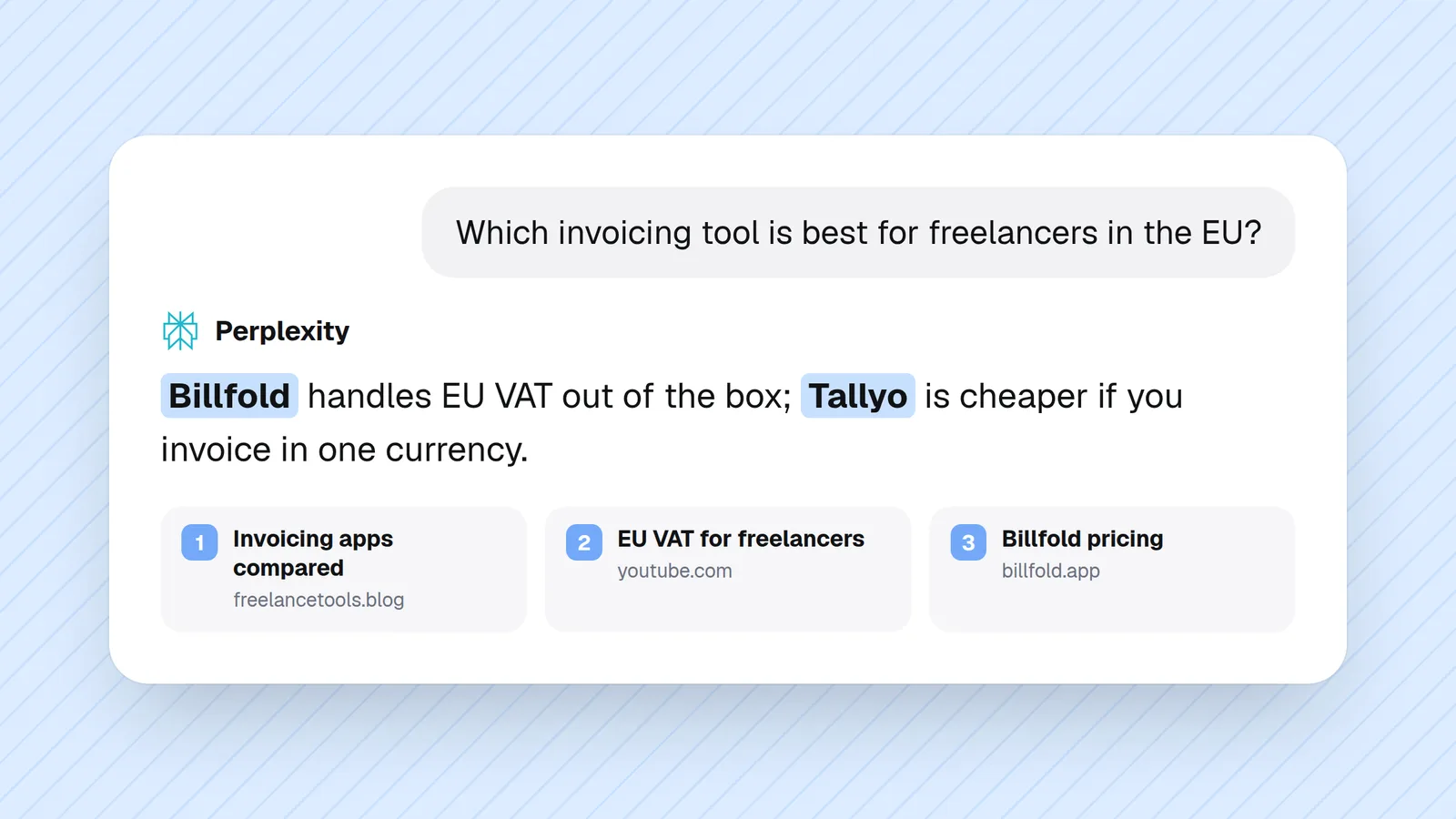
How Perplexity builds an answer
Perplexity is an answer engine built on search. For each question it runs one or more web searches, reads the top results, and writes an answer with numbered citations pointing at the pages it used. Unlike ChatGPT, it does not decide whether to search: it nearly always does, and it nearly always shows its sources.
That makes it the most transparent of the AI assistants for anyone trying to get onto its answers. Every citation is a page you can open, see why it was used, and either improve (if it is yours) or get onto (if it is not).
Two consequences follow. First, recency matters more than in a model's memory: Perplexity reads the live page, so an update can be picked up quickly. Second, the pages that win are the ones its searches find, which means ordinary search visibility for the question still counts.
Step 1: let Perplexity's crawlers in
Perplexity documents two user agents:
| User agent | What it does | robots.txt |
|---|---|---|
| PerplexityBot | Crawls pages to surface and link them in Perplexity's search results. Perplexity says it is not used to crawl content for AI foundation models. | Respected. Allow it to be eligible. |
| Perplexity-User | Visits a page when a user's question needs it, and may link it in the answer. Not used for crawling or training. | Perplexity says it generally ignores robots.txt, since a user requested the fetch. |
User-agent: PerplexityBot
Allow: /
Perplexity says robots.txt changes can take up to 24 hours to apply, and publishes the IP ranges of both agents (perplexitybot.json and perplexity-user.json) so you can allow them in Cloudflare, AWS WAF or another firewall. One-click "block AI bots" settings often catch PerplexityBot along with training crawlers; check yours. More in AI crawlers and robots.txt.
Step 2: be in the results Perplexity reads
Perplexity reads what its searches return. A page that does not come up for the question, or a close variant, is not read. In practice:
- Match the question, not the keyword. Perplexity questions are long and specific: "which email tool has the best deliverability for cold outreach under $50 a month". Pages that answer that exact need, with the constraint in the heading, are the ones that come up.
- Cover the sub-questions. A buyer question splits into several searches (price, a feature, a comparison). A page that answers the main question and its obvious follow-ups is read for more of them.
- Keep the page indexable in the ordinary way: a crawlable URL, a sitemap, no accidental noindex, content in the HTML rather than only rendered by JavaScript.
Step 3: write pages Perplexity can quote
Perplexity's answers are stitched from short passages, each with its citation. A page gets cited when it has a passage that answers part of the question on its own. What helps:
- The answer first. Put the direct answer in the first sentence under a heading that matches the question.
- Specifics: prices, limits, dates, version numbers, named examples. "From $29 a month for 3 users" is quotable; "affordable plans" is not.
- A visible date: "Updated November 2026" on a page about prices or tools tells a reader, and a system that prefers current pages, that it is current. Change it only when you change the page.
- Tables for comparisons: a table of plans or tools is easy to extract and cite row by row.
- Sources of your own. Figures with a link to where they came from are more credible to readers, and the GEO research found citing sources and adding statistics among the changes that raised a page's visibility in generated answers.
See how to write content AI assistants cite for a page template.
Step 4: get onto the pages Perplexity cites for your category
For recommendation questions, Perplexity draws heavily on third-party pages: "best X" lists, review sites, Reddit threads, YouTube videos and comparison pages. Ask it your buyers' questions, open every citation, and note which pages recur. Then:
- Lists and reviews: pitch the author or editor, with a trial and one sentence on who you are for.
- Communities: answer the threads honestly, as the maker.
- Video: Perplexity often cites YouTube for how-to and product questions; a short demo answering the exact question is cheap to make.
- Review platforms and directories: a complete profile with your current facts.
How to get your brand mentioned in ChatGPT has the full table of page kinds and what to do on each; it applies to Perplexity as is.
Step 5: measure it
Perplexity makes measuring easy, because every answer lists its sources. Keep a fixed list of buyer questions, ask them every few weeks, and record whether you are named, whether your pages are cited, and which pages are. Visits from Perplexity show in analytics with perplexity.ai as the referrer.
Answers differ between runs and between Perplexity's models, so ask important questions more than once and compare like with like. How to track AI search visibility covers metrics and cadence.
How Perplexity differs from ChatGPT
| Perplexity | ChatGPT | |
|---|---|---|
| Searches the web | Almost always | When the question needs it, or the user turns search on |
| Shows sources | On every answer, numbered | When it searched |
| Search crawler | PerplexityBot | OAI-SearchBot |
| User-triggered fetcher | Perplexity-User | ChatGPT-User |
| Training crawler | None, per Perplexity | GPTBot (separate from search) |
| Referrer in analytics | perplexity.ai | chatgpt.com, often with utm_source=chatgpt.com |
The work overlaps almost entirely: be reachable, be found, be quotable, and be on the third-party pages each engine reads. The pages each one cites for the same question do differ, which is why it pays to check both. See how to get cited by ChatGPT.
Questions people ask
Does blocking PerplexityBot remove me from Perplexity?
It removes your pages from what PerplexityBot crawls for search results. Perplexity-User may still fetch a page when a user's question needs it, since Perplexity says that fetcher generally ignores robots.txt. To be cited, allow PerplexityBot.
Does Perplexity use my content to train AI models?
Perplexity says PerplexityBot is not used to crawl content for AI foundation models, and Perplexity-User is not used for training either.
How quickly can a page start being cited?
Once PerplexityBot has crawled it and it comes up for the searches Perplexity runs. For a new page on an established site this can be days; Perplexity says robots.txt changes take up to 24 hours to apply.
Can I pay to be cited by Perplexity?
Citations in answers are not sold. Be wary of any service that promises them; pay only for work you can check, like a published review or a live listing.