How to track AI search visibility

Kaan Ersoy6 min read
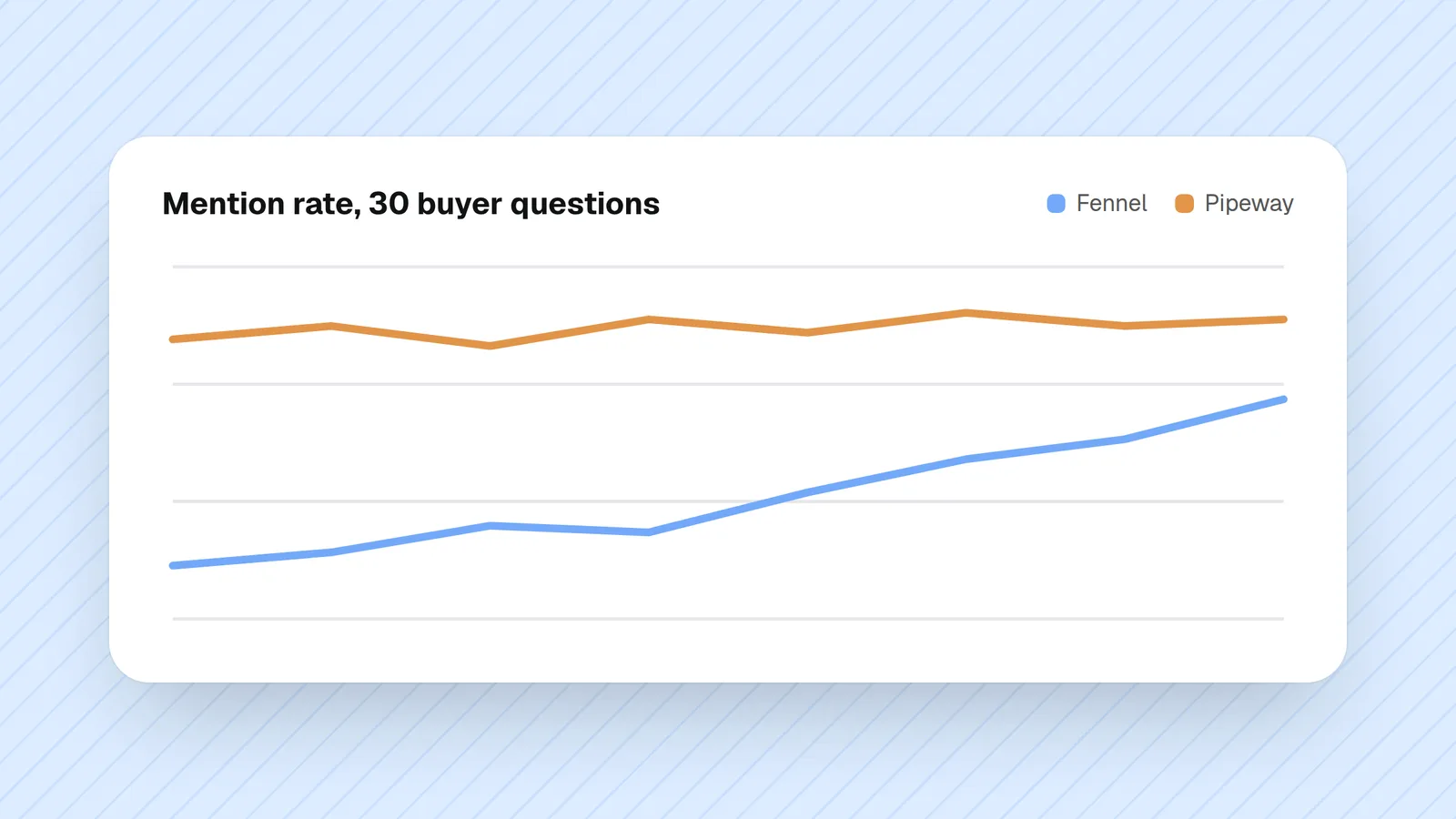
To track AI search visibility, fix a set of buyer questions, ask them on each AI engine the same way at a regular interval, and record who is named, in what position, and which pages are cited. From those records come the metrics that matter: mention rate, share of voice, citation rate and the list of cited sources. Add AI referral traffic from your analytics and Search Console for Google's AI features, and you have a picture you can compare month to month.
Why it is not like rank tracking
A search ranking is one number for one keyword on one day. An AI answer has none of that: it is written fresh each time, varies between runs, depends on the model and its settings, and names several brands at once. And no assistant publishes how often a question is asked.
So AI visibility is measured as a sample. You pick the questions that matter, ask them under controlled conditions, and track the share of answers that name you and link you. The quality of the tracking depends almost entirely on the quality of the question set.
Step 1: build the question set
Write 30 to 100 questions your buyers ask an assistant before buying, in their words. Good sources for them: sales call notes, support tickets, Reddit and forum threads in your category, "People also ask" boxes, and the search terms people use on your site.
- Leave your brand out. A question that names you is answered about you; keep it as a separate "brand check", outside the counts.
- Mix the shapes: best-for-a-need, alternatives to a competitor, head-to-head comparisons, and problem-first questions.
- Add the constraints buyers add: team size, budget, industry, country, the tools they already use.
- Tag each question by topic and stage, so you can see where you are strong and weak.
- Note the search demand behind each where you can (the Google volume of the nearest keyword). It is not prompt volume, but it ranks questions by how much people care.
Step 2: ask them the same way every time
Consistency matters more than volume. Decide once and keep:
- Which engines: at least the ones your buyers use. Commonly ChatGPT, Perplexity, Gemini, Google AI Overviews and AI Mode; Copilot and Claude for some audiences.
- Search on, for engines where it is optional, because recommendation answers come from search.
- A clean session: logged out, a temporary chat, or a fresh account, so history and memory do not shape the answer.
- Location and language matching your market.
- Runs per question: two or three for the questions that matter most, because answers vary.
Step 3: record the right things
For each answer, record:
| Field | Example |
|---|---|
| Question, engine, date, run | "best CRM for a 5-person agency", Perplexity, 2026-11-28, run 1 |
| Named brands, in order | HubSpot, Pipedrive, Zoho, You |
| Your position | 4 of 4 |
| How you are described | "cheaper, fewer integrations" |
| Cited URLs | every source link, in full |
| Whether a cited URL is yours | yes or no for each |
The description column catches wrong facts (an old price, a feature you removed) that quietly cost you recommendations.
Step 4: turn records into metrics
| Metric | How to compute it | What it tells you |
|---|---|---|
| Mention rate | Answers naming you ÷ all answers | How often you are on the shortlist |
| Share of voice | Your mentions ÷ all brand mentions | Your weight against competitors |
| Average position | Mean of your position where named | Whether you lead or trail the list |
| Citation rate | Answers linking one of your pages ÷ all answers | Whether your own pages are read |
| Top cited sources | Count of each cited domain and URL | The pages deciding your category |
| Source coverage | Top cited pages that name you ÷ top cited pages | How much of the field you are on |
Report each by engine and by question group. An overall number hides that you may be strong in Perplexity and absent in Google AI Mode, or strong on alternatives questions and absent on best-for-a-need ones.
Step 5: add AI referral traffic
Visits from AI assistants show in analytics by referrer. Common ones: chatgpt.com (ChatGPT also adds utm_source=chatgpt.com to many links), perplexity.ai, gemini.google.com, copilot.microsoft.com and claude.ai. In GA4, a custom channel group or an exploration filtered on those referrers gives you AI traffic as its own line.
Google's AI Overviews and AI Mode are different: their clicks are counted in Search Console's Performance report under Web, mixed with classic results, with no separate filter. Watch the pages and queries you track there alongside your question set.
Traffic undercounts influence. Many buyers read the answer, remember the names, and later search the brand directly. Rising branded searches can be a sign of AI visibility too.
How often to check
Monthly is enough for most brands, and every two to four weeks while you are actively working on sources. Answers change with the pages they read and with model updates, so a single bad week is noise; a trend over two or three readings is signal.
Change one thing at a time where you can, and note what you changed and when, so a move in the numbers can be matched to the work. A tracker measures; it cannot prove what caused a change.
By hand, or with a tool
By hand works for 20 to 30 questions on two or three engines: a spreadsheet and an afternoon a month. Past that it becomes a job.
Tools come in two shapes. Monthly trackers (Peec AI, Otterly.AI, Profound, and the AI features in Semrush and Ahrefs) run your prompts daily or weekly and chart the trend. A one-time report such as Citable asks your buyer questions once on ChatGPT, Gemini, Google AI Overviews, Google AI Mode and Perplexity, and returns the cited sources, the competitors on them, and whom to contact to get onto each; a new report later shows what moved. Which fits depends on whether you need a daily chart or a list of things to do. Compare them in AI visibility tools.
Questions people ask
How many questions do I need?
Thirty is a useful minimum to see patterns; 50 to 100 gives more stable numbers and lets you split by topic. Fewer, well-chosen questions beat many vague ones.
Why do my results change from day to day?
AI answers are generated fresh, and the pages they search can change. Ask important questions more than once and look at trends across readings, not single answers.
Can I see AI Overviews traffic separately in Search Console?
No. Google counts it in the Performance report under the Web search type, together with other search traffic.
Is prompt volume available anywhere?
No assistant publishes it. Tools that show "prompt volume" estimate it from search data or panels. The Google volume of the nearest keyword is an honest proxy, as long as it is called search demand.