AI SEO vs traditional SEO: what changes and what doesn't

Kaan Ersoy5 min read
Traditional SEO gets a page ranked in a list of links; AI SEO (also called GEO or AEO) gets a brand named and cited inside a written answer. The foundations carry over, because AI assistants search the web before answering: pages still need to be crawlable, indexable, relevant and trusted. What changes is the target (the answer, not the rank), the query (long questions with constraints, not keywords), the unit (a quotable passage, not a page), the role of other sites (the content answers are written from, not only backlinks), and how you measure it.
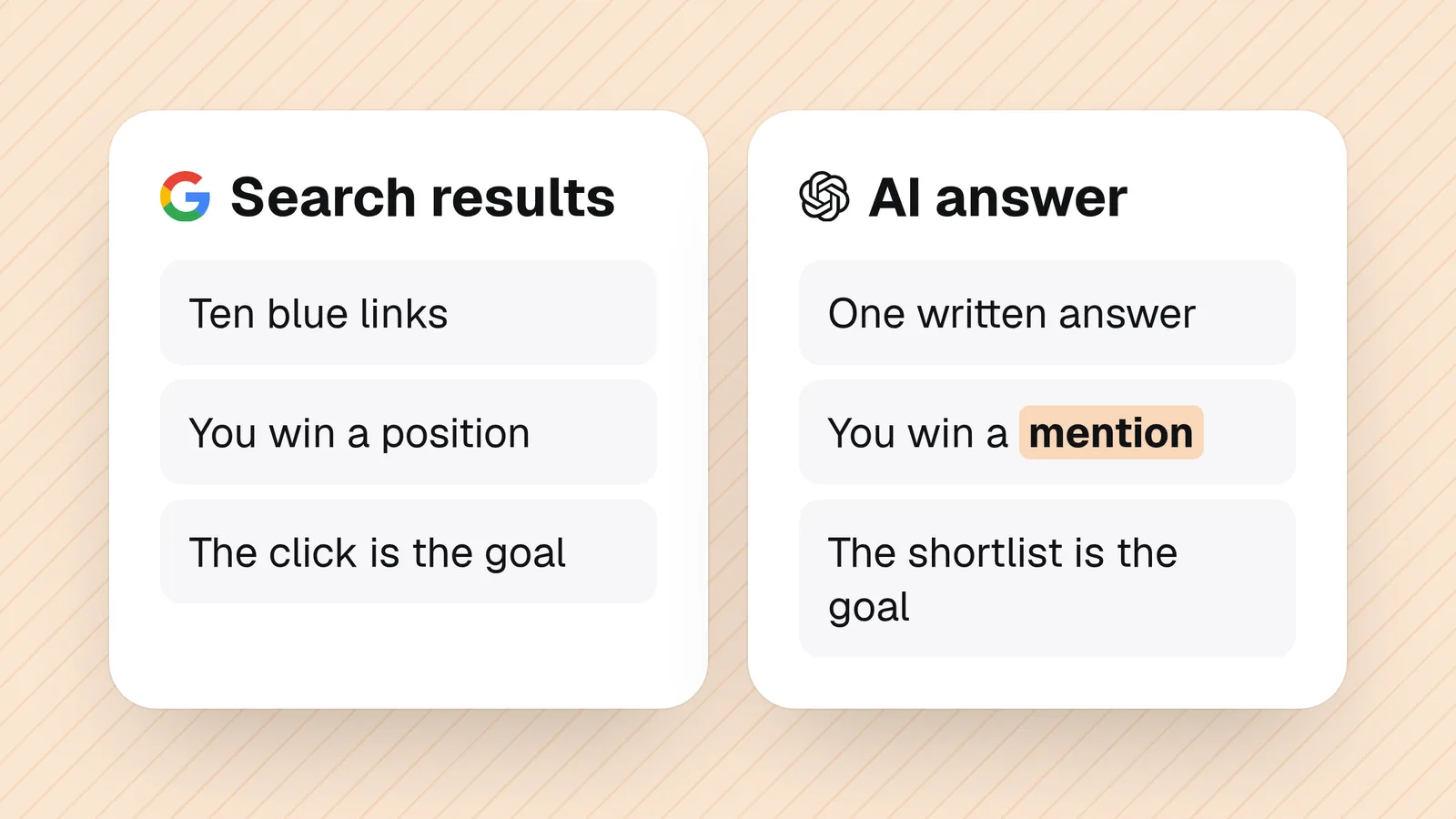
Side by side
| Traditional SEO | AI SEO (GEO, AEO) | |
|---|---|---|
| What the user sees | Ten links and some features | A written answer, a few named brands, a few source links |
| The goal | Rank high and get the click | Be named in the answer, and linked as a source |
| Queries | Short keywords, 2 to 4 words | Full questions, often 10 to 25 words, with constraints |
| Unit of optimization | The page | The passage, and the brand across many pages |
| Crawlers | Googlebot, Bingbot | Those plus OAI-SearchBot, PerplexityBot, ChatGPT-User, Perplexity-User |
| Other sites | Mostly as backlinks | As the pages answers are written from |
| Main measure | Position, impressions, clicks | Mention rate, citations, share of voice on a question set |
| Feedback loop | Search Console, rank trackers | Re-asking the same questions; AI referral traffic |
What stays the same
More than most AI SEO marketing suggests. Every major assistant searches before answering product, comparison and current questions, and Google's AI Overviews and AI Mode come straight from Google's index. Google states that there is no special optimization for its AI features beyond being indexed and snippet-eligible. So:
- Technical SEO still decides whether you are read at all: crawlability, indexability, content in the HTML, speed, clean canonicals.
- Relevance and quality still decide whether you are found by the searches the assistant runs.
- Authority still matters: sites that are widely referenced are found and read more.
- Helpful, people-first content (Google's phrase) is what both systems are built to reward.
If your SEO is broken, fix that first. AI SEO built on pages nobody can find does not work.
What changes: the queries
People type keywords into Google and ask questions of assistants. "CRM small business" becomes "what's the best CRM for a 5-person agency that already uses Google Workspace and needs a free plan". That has consequences for what you write:
- Pages should target needs with constraints (team size, budget, industry, integration, location), not only head terms.
- Headings should use the buyer's wording of the question, because a passage under a matching heading is the easiest to lift.
- Keyword volume tools undercount these questions. Sales calls, support tickets and community threads are better sources for them.
What changes: the content
An AI answer is stitched together from passages. A page gets used when it contains a passage that answers part of the question on its own. In practice that rewards:
- Answer-first paragraphs: the answer in the first sentence, the nuance after.
- Specifics: prices, limits, figures, dates, named examples, each with its source where it has one.
- Tables for comparisons and lists for steps.
- Consistency: the same category, description and facts on every page and profile, so the engine does not have to reconcile versions.
The GEO research paper that named the field found that adding sources, quotations and statistics raised pages' visibility in generated answers, while keyword stuffing did not. Long intros, vague claims and keyword repetition are what AI SEO punishes most visibly. See how to write content AI assistants cite.
What changes most: other people's pages
In SEO, other sites matter mainly as links pointing to yours. In AI SEO they matter as content. For "best X" and "X vs Y" questions, the answer is typically written from list articles, review sites, Reddit threads, YouTube videos and comparison pages. If those pages name your competitors and not you, the answer will too, however strong your own site is.
So off-site work moves from "earn a link from a high-authority domain" to "get named, accurately, on the specific pages the assistants read for my buyers' questions". Sometimes those overlap. Often the page that decides an answer is a niche blog post or a two-year-old Reddit thread that no link-building list would pick. The way to find them is to ask the questions and read the sources. How to get your brand mentioned in ChatGPT goes through it step by step.
What changes: measurement
There is no rank to track in an answer, and assistants do not publish how often a question is asked. AI SEO is measured on a fixed set of questions you choose:
- Mention rate: the share of questions where you are named.
- Citation rate: the share where one of your pages is linked.
- Share of voice: your mentions against all brand mentions in the set.
- Cited sources: which pages the answers draw on, and which name you.
- AI referral traffic: visits from chatgpt.com, perplexity.ai, gemini.google.com and others in your analytics.
Google's AI features are reported inside Search Console's Web performance, mixed with classic results. How to track AI search visibility covers all of this.
Where to spend the next hour
- If your SEO basics are broken, fix them. Everything else rests on being found.
- If your site is sound but AI answers name competitors, spend it on the third-party pages those answers cite.
- If you are named but described wrongly, fix the facts on your site and every profile, so they agree.
- If you are named and cited, keep a question list and measure it, so you notice when it changes.
Questions people ask
Is AI SEO just SEO with a new name?
Partly. The foundations are the same, because AI assistants search the web. The differences are real: questions instead of keywords, passages instead of pages, and third-party pages as the content answers are written from.
Will AI search replace Google?
Not as a whole so far, and Google is itself an AI search engine now, through AI Overviews and AI Mode. Buyers increasingly use both, so it pays to be visible in both.
Do backlinks matter for AI SEO?
They still help pages be found and trusted in the searches assistants run. But for recommendation questions, being named on the cited page matters more than whether it links to you.
Should I write content specifically for AI?
Write for the buyer's question, answer-first and specific. That is what both search engines and AI assistants are built to reward; content written for a machine rarely helps either.